Friday, September 23, 2011

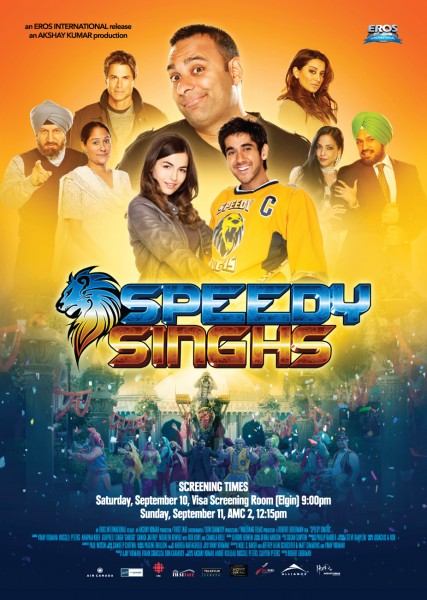
Speedy Singhs – Salute The Singhs

Director: Robert Lieberman

Actors: Vinay Virmani, Russell Peters, Rob Lowe
Rating: 3.5 out of 5

In 2002 Gurinder Chadha gave cinematic representation to the immigrant angst of British Indians using the metaphor of football and a girl who could ‘Bend It Like Beckham’. Another country with a sizable Indian population now gets its own version of the same in ‘Speedy Singhs’ aka ‘Breakaway’, this time with Canada’s favourite sport – ice hockey. Surprisingly this one almost pulls a ‘Bend it…’ out of its turban.

In Toranto, the son of second generation immigrant Rajveer Singh (Vinay Virmani), dreams of making it big in ice hockey. His worldly-wise father (Anupam Kher) knows better and dissuades him. Rajveer’s modern individualism clashes with the traditionalism of his father. Unwilling to either hurt his father, or give up on his dreams, no matter how impossible, he plans and all Punjabi ice-hockey team in secret.

First, let’s get the problems out of the way. Yes, it’s clichéd and very predictable. But like in life, in film the journey is more important than the destination. And this is a journey whose scenery you’ll fall in love with.

Director Robert Lieberman sets the stage for the clash of civilizations, but in a non-serious and fun manner. Thus while in ‘Bend it..’ you had a daughter having a face-off with her traditional mother, here it’s the father-son pair with bad blood running between them. And though it does not exactly reach the heights of ‘Bend it..’, quite often it does knock on its door.

The quick, witty writing delivery without much ado by the actors, keeps the fun on the go in the film. Vinay Virmani is good, but could definitely have been better. Russell Peters is his comic, nasty self. But it is the ever reliable Anupam Kher, who brings out the quite anguish of a father who loves his son but cannot come to terms with his rebellion. His believable performance that never goes over the top, sets the stage for the film.

The film, though clichéd, thankfully stays away from overusing some stereotypes, like that of the bad, white hockey player (though they are shown bad, but not physically abusive enough), or that of a typical Punjabi household in ‘Kanada’ and leaves Indian-American-English out of the brutal rape it has faced in other North American films.

Though not self-deprecating, ‘Speedy Singhs’ does not take itself seriously thus proving to be a perfect feel-good family outing. It gives the ever prominent Indian community in Canada, the cinematic space they deserve, which so far had been denied to them. 

Here’s saluting the Singhs, Akshay Kumar and everyone else who made this fun, little film possible. Let’s bring home some more. 

Saturday, September 17, 2011

Warrior – Family Is Worth Fighting For

Director: Gavin O’Connor
Actors:  Joel Edgerton, Tom Hardy, Nick Nolte, Jennifer Morrison
Rating : 4 out of 5
In a normal feel-good, fighting-the-odds film, you root for the protagonist to win. Like in Rocky. In the end when s/he is being beaten you wish for a ‘miracle’, which is usually delivered. Now imagine a film in which you are rooting for both the opponents in the ring, wanting both to win and none to lose. Writer, director Gavin O'Connor brings you just that impossible story.
Two brothers with diametrically opposite personalities and fighting styles, from a broken family, find themselves facing each other in a mixed martial arts contest with both having reasons compelling enough to desperately want to win.
Once upon a time, in Hollywood, action films were purely action filled. Where there were beefy men who fought the odds and emerged victorious in the end. Lately however, in this genre, as in many others, just like mixed martial arts, we have mixed genre movies that try to blend in elements of one genre with another. And though there have been many that have tried to blend action and family drama, very few have succeeded with the right delicate balance like Warrior does.

Despite its action, this is predominantly a family film. It is the story of broken men, emotionally charred men, yet men who are good at heart, who at the core of it long for the comforts of a family. And it is family that becomes the leitmotif of the film. The older brother fights to protect his family, while the younger one fights because he wants to help the family of a fallen comrade. And the underlying motive for them is the happiness they never had growing up in a family life with a drunken father.
It is in travelling the landscape of family life that Warrior scores an ace. Though things are merely hinted at, but the violence – both physical and emotional - of the family life that the two brothers have endured, make them the men they become, giving them the drive to protect families they know and sets them off for a riveting final confrontation.
The film, very adeptly, makes no judgment on its characters. It just lays out the stories and the scars the characters carry, without ever judging any of them. This and the riveting ending where neither brother really loses – one gets the money the other the family he had not had for long - makes the film that much more compelling.  
Writer and director Gavin O'Connor, returns to the space he is most comfortable with - soaring sports film about fighting and winning against the odds. His previous such outing with Miracle (2004), is not just an eternally inspiring story, but also inspired many copies, including our very own ‘Chak De! India’ starring Shahrukh Khan.
Warrior is riddled with clichés and inconsistencies. Hence it becomes a special treat to see it grappling with them, and rising from them to build a physically and emotionally high-voltage drama. There’s plenty of inspiration for Bollywood in this film, on how to revive the separated-brothers genre, and make it viable for today’s viewers.
This review has been written for wire service, Indo-Asian News Service (IANS)

Friday, September 9, 2011

Contagion – A Spine-Chillingly Real Tale


Director: Steven Soderbergh
Actors: Matt Damon, Kate Winslet, Jude Law, Gwyneth Paltrow
Rating: 4 out of 5

Disaster movies, where humanity faces an unassailable enemy in the form of a meteor, floods, virus, aliens etc. are aplenty.  It would hence take a genius to make another yet make it feel fresh enough for it to be enjoyable and terrifying. Steven Soderbergh with Contagion, is that master.

Its genius lies in its matter-of-fact approach without literally making a statement on anything, either humanity or the possible theories behind an epidemic as also in not using melodrama to raise empathy. In the world of twists and counters twists, Contagion treads a near straight line, yet manages to give one the shivers.

After a trip to Hongkong, Beth (Paltrow) falls sick and in a few days, dies. Even before her husband can come to believe it, their son dies similarly. Before researchers even identify the virus, hundreds of people all over the world begin to die. As the global health bodies jostle to figure what’s happening, an epidemic breaks out that threatens to destroy the political, social and economic structure of the world as mobs run riot and anarchy rules. How humanity survives it, forms the later part of the film.

Contagion is the story of one virus’s journey through humans, its exponential multiplication and final elimination. Unlike many other virus disaster films like ‘28 Days Later’ or ‘I Am Legend’, it is not a horror film. Yet, it is much more terrifying for this one seems chilling possible, as SARS, Bird Flu and others have proven.

And it doesn’t take a meteor like in the underrated masterpiece Deep Impact or Armageddon; not even aliens like in ‘Independence Day’; nor even global warming as in ‘2012’ to threaten human life and bring the world to its knees. It takes one small, invisible virus.
Credit goes to the stellar cast who believed in the film enough to do bit roles

Contagion is a spine-chilling tale because it literally, and very simplistically shows how a conveniently connected world, could actually become a problem in such a case. And how the well oiled governmental machinery globally could collapse under such an onslaught.

If one were to look at parallels or metaphors, they are aplenty. Consider for example, the financial contagion of 2008-09. The virus of greed, that first showed symptoms in America, nearly took down the world, till two years later, the same time it takes to control the virus in the film, it was controlled and the world limped back to normalcy.

Face it, we live in a world where there maybe physical borders, but which is so well connected that viruses - be that on bodies or computers or financial systems, can spread rapidly through the world and systematically destroy everything. Thus, without attempting to make a statement Contagion decimates the stupid notions of nationality and borders and paints the world as one extended body, where problems in one part, even one human in this case, can affect and destroy the world as we know it.

And it is to the credit of a dream, ensemble star cast who not only do bit parts in a film they believed in, but also give their best.

One can only hope, pray, wish that the scary possibility of such a story, stays confined within cinema halls and that we actually never see it. 

This review has been written for the wire service, Indo-Asian News Service (IANS).

Friday, September 2, 2011

That Girl In Yellow Boots – Good News For Indian Cinema


Director: Anurag Kashyap
Actors: Kalki Kochelin, Prashant Prakash, Nasseruddin Shah
Rating: 4 out of 5

The 60s were wonderful time for Indian cinema. The government set up FTII to impart cinema education and FFC (Film Finance Corpration) to fund creative cinema. The result – beginning 1969 India saw what is today called ‘The New Indian Cinema’ that resulted in some of the greatest films ever made in the nation.

Recently, with the onslaught of digital filmmaking, little droplets of creative cinema have been foreshadowing another cloud-burst of creativity. However it needs patronage. Perhaps NFDC, transformed from FFC, would provide that shot in the arm to extremely talented, but unfinanced filmmakers in India. And ‘The Girl In Yellow Boots’ (TGIYB), co-funded by NFDC, could be that game changer.

A British national of Indian origin, Ruth (Kalki), is in India looking for her dad who had left her when she was young. To fund her trip she works in a shady massage parlor charging Rs. 1000 to give ‘happy endings’ to her customers. She is caught up in her druggie boyfriend’s mess but a greater mess awaits her in the discovery of her father.


TGIYB is good news for Indian cinema for many reasons. Firstly it is perhaps India’s first commercially released film to be not just entirely shot in digital (LSD was the first) but for it to be shot on cameras that are usually used to shoot stills. Seeing what digital can do on big screen, like LSD, an experience and lesson in filmmaking.

Secondly it will perhaps become the second innings of NFDC. The brilliant films produced by its precursor FFC in the 70s and 80s will vouch for the veracity of how much creative cinema needs and deserves governmental patronage. In a few months time NFDC will also release Dibakar Banerjee’s ‘Shanghai’.

Shot in 13 days, TGIYB is spot on in almost all departments. It is carried forward by a stellar performance from its cast, especially Kalki Kochelin, who’s also the co-writer.

TGIYB is a statement on modern life and society. The character of Ruth, despite her seeming loss of innocence and purity, is the purest character in the film. Yet, like a beautiful flower in full bloom, she is trampled upon by a ruthless society that ceaselessly uses her. Her yellow boots becomes a metaphor for the beauty and cheer that is stolen from her.

Violence, though rarely physical, is inflicted upon her till she becomes insensitive to the innocence of another like her. Her trampling seem complete, till in the end she redeems himself, by refusing to act as per her impulse.

This is a typical Anurag Kashyap film as it returns us to the themes that form the backdrop in many of his films – sex, drugs and violence. The quirky characterization and the pun of language is all there. Who else can pun a name ‘Chittiappa Gowda’ and pull it off or juxtapose the banal telephonic conversation of a chatty woman and serious confrontation on phone between mother and daughter at the same time?

Yet, the film is also atypical of Anurag for unlike his other film he exercises great restraint. And it is in this control, of not ending the film in violence, lies its greatest power.

The time is ripe for another cinematic revolution in the country, where filmmakers are not shackled by nepotistic and uncreative production houses and corporate houses married only to profits. Hopefully TGIYB will prove to be the first, in the many to follow.


This review has been written for the newswire service, Indo-Asian News Service (IANS)

Wednesday, August 31, 2011

Bol – Speak Up For This Little Masterpiece

Director: Shoaib Mansoor

Actors: Humaima Malick, Manzar Sehbai, Atif Aslam
Rating 4 out of 5

Pakistan, in contrast to India - the largest film industry in the world, barely makes a handful of films every year. To see a Pakistani film that is better than most commercial Indian films, is embarrassing. Bol, despite its few flaws, becomes that minor masterpiece that puts Bollywood to shame.

A woman sentenced to death, recounts her story of growing up in the shadow of an oppressive father who denies his girls their fundamental rights.

At the face of it, the film seems apolitical. However, one of the feminist movement’s clarion reasoning for action against oppression has been that the personal is political. And it is this politics in the personal story of this family, that writer-director Shoaib Mansoor of ‘Khuda Ke Liye’ handles with élan.

Shoaib Mansoor manages a very difficult task of taking up many issues without losing focus on any. You thus have issues of women’s emancipation, transsexualism, right to education and religiosity etc. handled with care enough for the audience to feel for each. The layers in the script itself make it a worthwhile watch. And that the film opens up gradually like an engaging mystery, keeps the viewers engrossed.

To carry so much loads on its shoulders the film needed some superlative performances. It has this in Humaima Malick who portrays the angst of a girl who itches to do the right thing and Manzar Sehbai who is stellar in his performance of a pigheadedness, hypocritical man.

The songs are catchy, especially ‘Kaho’ - the least one can expect from a Pakistani film considering their strong musical scene. The only problem however, is its melodrama that sometimes does get overbearing. But it is a small flaw, amidst its many skills. 

At first look it is easy to denounce it as a statement against the oppression of women under Islam. That is indeed true, considering that women’s emancipation has yet failed to touch Muslims to a significant extent. Yet, to call the film just that would be an insult to its intelligence. For what it does in the chauvinist, hypocritical and obnoxiously religious character of the father, is create a template for closed-minded men everywhere. His stubbornness and manhood, is a metaphor for ‘the’ manhood that causes war and destruction everywhere.

Replace the Muslim Hakim, with a staunch Hindu man, and set the film in India, and it would be true frame by frame. If you look at the treatment of women in India, it is often worse with literally hundreds of thousands of women being killed before birth or during it annually in India. Female infanticide is one of the most obscene elements of Indian, Hindu society. Also almost in every village, small town and city in India you’ll find scores of such cases of chauvinist men doing worse to their wife and girls.

Asia’s most revolutionary poet, Faiz Ahmed Faiz, in one of his most rousing poems, had written, ‘Bol ke lab azad hai tere..’ (Speak that thy lips are free). In this, and in the film, lies a message for us all, to speak out against oppression, be it in the political sphere or the personal. The current anti-corruption movement under Anna Hazare has shown the power of this ‘Bol’. When many in chorus scream, “I’m mad as hell and I’m not gonna take it anymore,” things change. Are you mad enough yet? If not, watch Bol, and you will be.

This review has been written for the wire service, Indo-Asian News Service (IANS).

Saturday, August 20, 2011

The Devil’s Double – Masterful Subtexts, Stunning Performance


Director: Lee Tamahori
Actors: Dominic Cooper, Ludivine Sagnier and Raad Rawi
Rating: 4 out of 5

The US, has been preoccupied with Iraq for decades. After 911, its politicians cooked up reasons for a real occupation. That preoccupation and occupation, continues with The Devil’s Double, that carries an Oscar worthy, scintillating performance by Dominic Cooper. His performance would have been enough to watch this film, but its extremely interesting subtexts makes this a must watch despite its many flaws as a film.  

A soldier, Latif Yahia (Dominic Cooper), is summoned from war to become the body double of Saddam Hussain’s son Uday Hussain (Dominic Cooper) – a psychotic, erratically violent, sex and drug obsessed fiend. This family loving and god-fearing man finds it difficult to imitate a monster leading to confrontation that threatens his and his family’s existence. 

The film is a masterpiece of deception. At the face of it, the film seems to portray the devilish life of Iraqis under a dictator – Saddam Hussain. And it does seem so when one considers the excesses of Uday Hussain and how his father tolerates him. However, this is actually a masterful deception that even Houdini would have been proud of.

For hidden inside this deception, is actually a positive portrayal of both Saddam Hussain and everyone else in Iraq. Saddam is even shown trying to kill his devilish son, only to be stopped at the last moment. The people who work for him are all honest and god-fearing in their own way. The citizens in the nation, enjoy a good life and girls are shown wearing skirts to school, much against the burqa-clad impression people have of any middle eastern country. The only devil in the picture, is Uday.

The political subtexts of the film are thus well hidden. It seem to suggest tacitly, if you consider current global politics today, that like Uday in the film, the devils who invaded and raped the otherwise beautiful and fairly peaceful country, are Americans.

Uday thus becomes a symbol of the Americans, and his double Yahya, of the innocent Iraqi forced into an occupation they did not seek or deserve. Yes, like Yahya, the citizens were in the midst of their own conflict under Saddam, but the American occupation multiplied it exponential times.

And in that, this surprisingly apolitical film becomes one of the strongest political films, and an indictment of American policies in Iraq. Its politics is hidden in a veneer of Uday’s brutality. Kudos to the writers and director to have pulled this off with such finesse.

The greatest strength of the film is the explosive performance of Dominic Cooper. He plays the nervous energy of a madman and immediately afterwards the nervousness of another man trapped by that energy with equal élan. His performance as Uday, has the same intensity of a Daniel Day Lewis playing Christy Brown in My Left Foot. Daniel won an Oscar for that film. Will Dominic win for this one?

As a film however, its varying pace is a little disconcerting. And so is its melodramatic ending. However, the entendre and the double entendres, the images and splitting images, the deception and the double deceptions, makes this a masterful creation despite its flaws that will keep the viewers engaged till the end. Hopefully, much longer than that.

This review was written for, and copyrighted by the wire service, Indo-Asian News Service (IANS).  

Saturday, August 13, 2011

Winnie The Pooh – The Best Animated Film Of 2011?

Rating: 4.5 out of 5

Directors: Stephen J. Anderson, Don Hall
Voiceovers: John Cleese, Jim Cummings, Bud Luckey, Craig Ferguson, Jack Houlter

Today there’s no limit to what a filmmaker can do with animation. The limit is set by his or her imagination. To understand how, watch Winnie The Pooh, a film that has the look of a Disney movie from 30 years back, but feels fresh and magical, just like the original books by A A Milne has been to millions.

In Ashdown Forest lives a group of animals and a boy who are best of friends. After the perennially gloomy donkey Eeyore loses his tail, his friends try to find it. But Pooh the bear, driven by hunger, simply can’t get hunny (honey) out of his mind.

The Winnie The Pooh series of books, with its warm, simple stories of friendship and fun, have captivated the imagination of millions of kids for over 8 decades now. There have been films and shorts and animated series on the same, the most famous being the 1977 film.

If you know Hollywood executives with no sense of cinema, you’d know that they would have wanted to alter this classic and bring out a ‘new’, ‘modern’ film. Thankfully, they have resisted this temptation and the film instead focuses on the essence of Winnie The Pooh which for kids represents the innocence of friendship and for adults the magnificent Shangri-la full of wondrous nature and animals and imagination that their childhood had been.

In the process Disney has managed to make a truly universal film that babies barely a few days old, oldies in their death bed and everyone in between can enjoy. Not many films, after Charlie Chaplin’s masterpieces, can claim the same credit. Yet, behind this simple, funny tale are some invaluable lessons that as adults we tend to forget – of love, of friendship, sacrifice and the love of nature.

A daft owl pretending to be smart who’s always writing his biography, a perennially depressed donkey, a resourceful piglet, a bouncy tiger, a red balloon with his own moods… where else will you find such an ensemble of quirky characters that charm with their simplicity.

What will however inspire and amuse adults quite a bit, is its intelligent and quirky writing. The potential of the English language to tie itself into knots and tickle the funny bone has been squeezed to the hilt. Particularly delightful is a pun with the word ‘not’ which leads to a hilarious misunderstood communication between the characters.

This is how films once used to be – simple, innocent, intelligent and eternal in its reach. Advancement in animation technology has actually sent animation cinema to the gallows. Out comes Winnie The Pooh to remind us of what is most crucial in a film, it’s heart. And that the best special effect in any film is not what you see on screen, but what you induce in the mind of the viewer.

If a filmmaker is ever in doubt of what cinema should be, s/he merely needs to replay this film. For everyone else, you can play it when you’re happy, you can play it when you’re sad. And you ought to especially play it when the rush of modern life makes you a tad too mad. A A Milne and Walt Disney would have loved this.

This review has been written for, and hence copyrighted by Indo-Asian News Service (IANS).